Tree of Life Multilayer PaperCut Files: 3D SVG for Shadow Boxes
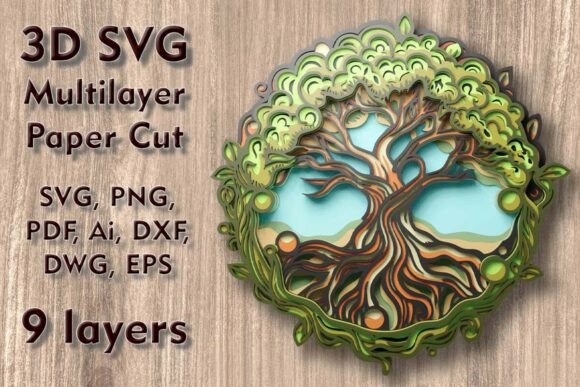
As a graphic designer who’s built brand identities for handmade studios, wellness boutiques, and seasonal Etsy launches, I recently evaluated the Tree of Life Multilayer PaperCut Files for a real client project: a small-batch herbal apothecary launching a “Rooted Rituals” collection. The goal was cohesive visual storytelling across packaging, social media, and in-store shadow box displays. My first impression? This isn’t just clipart—it’s a layered, dimensional graphic design asset with intentional negative space, rhythmic line weight, and organic symmetry that immediately evokes growth, connection, and quiet reverence.
A Mood That Anchors Brand Voice—Not Distracts From It
The Tree of Life Multilayer PaperCut Files delivers a warm, hand-crafted modern design sensibility—neither overly ornate nor sterile. Its three distinct layers (trunk, mid-canopy, outer branches/roots) create subtle depth without visual noise. For the apothecary, it reinforced their core messaging: grounded ingredients, interwoven traditions, and mindful consumption. Unlike flat illustrations or generic botanical vectors, this asset carries emotional appeal through its implied tactility—like something you’d trace with your finger on a pressed linen label or see catching light in a walnut-framed shadow box.
Where It Elevates Real Client Deliverables
In practice, the Tree of Life Multilayer PaperCut Files performed exceptionally well across multiple touchpoints:
- Packaging design: Scaled cleanly to 3.5″ x 3.5″ on glass apothecary jars—used as a debossed foil accent on matte kraft labels, then mirrored in die-cut window overlays.
- Social media graphics: Layered over soft-gradient backgrounds in Instagram carousels; its clear silhouette ensured readability even at thumbnail size.
- Printable design & product mockups: Embedded into Canva templates for digital lookbooks and used to generate realistic Cricut project previews for the client’s DIY workshop kits.
- Merchandise & sublimation design: Printed flawlessly on ceramic mugs and organic cotton tote bags—no pixelation, no lost detail, thanks to the clean vector paths in the SVG design.
- Editorial design & web design: Served as a hero graphic on the client’s homepage banner and as a recurring decorative element in blog headers—always reinforcing brand consistency without competing with body text.
Strategic Placement: Where This Asset Shines (and Where It Doesn’t)
This is a supporting creative design—not a standalone logo design. It excels in large layout areas: hero sections, wall art concepts, packaging backgrounds, and themed collections. It adds richness to campaign visuals and elevates printable wall art without feeling cliché.
Use it carefully in contexts demanding extreme clarity or restraint: small app icons, minimalist corporate reports, or branding systems built around ultra-thin sans serif fonts and monochrome palettes. Its layered nature can weaken visual hierarchy if dropped into crowded layouts or low-contrast designs—especially over busy textures or photos with competing organic shapes. It also doesn’t translate well to strict professional corporate materials where neutrality and scalability trump expressive warmth.
Design Judgment: What I Tested Before Approving for Client Use
Before clearing the Tree of Life Multilayer PaperCut Files for commercial license use, I ran these practical checks:
- Tested black-and-white output—confirmed crisp separation between layers with no unintended bleeding or hairline gaps.
- Previewed on both light and dark backgrounds—verified contrast holds across all three layers, especially the delicate outer branches.
- Resized from 2″ to 24″—noted excellent scalability in SVG format; warned the client against reducing below 1.75″ due to fine line integrity.
- Placed on real product mockups (glass jars, wood boxes, linen pouches)—assessed how shadows and material texture interacted with the layered cutout effect.
- Checked print quality on uncoated paper stock—no ink spread, clean edges, no rasterization issues.
- Reviewed file formats: SVG (fully editable paths), high-res PNG (crisp transparency), and included layer-named AI files—ideal for custom color blocking or selective masking.
- Compared against common font pairings: paired beautifully with serif (Playfair Display), balanced well with clean sans (Montserrat), but overwhelmed delicate script fonts—used sparingly with handwritten styles.
- Confirmed commercial license covers resale in physical products (e.g., printed cards, mugs) and digital products (e.g., Canva templates, printable design bundles).
Why It Earned a Spot in My Design Toolkit
This isn’t just another digital product—it’s a versatile, emotionally resonant graphic design asset that bridges handmade business authenticity with polished commercial execution. For designers supporting small business branding, it solves real problems: adding tactile sophistication to flat digital assets, creating cohesive visual motifs across channels, and delivering ready-to-use depth for shadow boxes, packaging, and social media graphics—without requiring custom illustration time.
It strengthens brand recognition by offering a distinctive yet timeless motif—more memorable than stock foliage, more adaptable than rigid iconography. And because it’s built as a 3D SVG for shadow boxes, it invites dimensional thinking: how light falls, how layers align, how meaning deepens with physical presence. That’s rare in off-the-shelf design assets.
If you’re sourcing for an Etsy product launch, a print-on-demand store, a local event series, or a wellness brand refresh—the Tree of Life Multilayer PaperCut Files is worth evaluating not just for what it is, but for how thoughtfully it integrates into a larger creative ecosystem. Just remember: test early, scale intentionally, and always anchor it in purpose—not decoration.