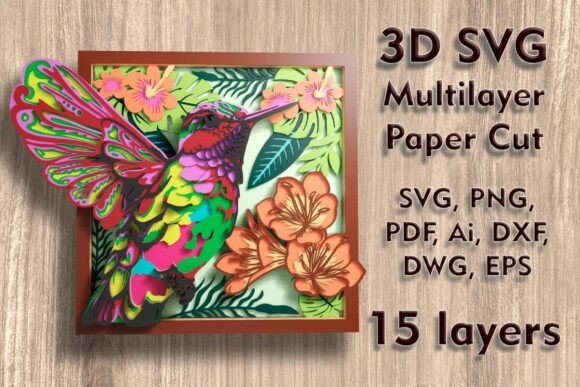
Hummingbird 3D Shadow Box PaperCut Files
A Delicate, Layered Impression—Before the Needle Touches Fabric
The first thing that strikes me about Hummingbird 3D Shadow Box PaperСut Files isn’t its size—it’s its quiet confidence. At 375 x 300 mm (14.8 x 11.8 in), it’s clearly designed for impact: a layered, dimensional hummingbird poised mid-air, wings slightly angled, tail fanned, body lifted with subtle depth. This isn’t a flat silhouette—it’s a multilayer SVG built for visual hierarchy, where each cut layer implies shadow, volume, and movement. As an embroidery designer who regularly translates paper-cut aesthetics into stitch, I immediately see how this could translate to satin-stitched wings over fill-stitched bodies, or delicate running-stitch outlines framing airy negative space. It feels like a design made *for* interpretation—not rigid instruction.
Where It Truly Shines: Real Projects, Not Just Mockups
Last week, I used a scaled-down version of Hummingbird 3D Shadow Box PaperСut Files on a custom linen tea towel for a local boutique owner. We chose a soft sage background with ivory thread—no dense fills, just clean satin wings and gentle fill-stitch body layers. Customers paused at the counter. Not because it shouted, but because it *breathed*: light, precise, and unmistakably handmade. That’s the strength here. It works beautifully on structured items like pillow covers and aprons where fabric tension supports fine detail. On a baby onesie? Yes—but only if you simplify the inner wing layers and reinforce with tear-away + cutaway stabilizer. For sweatshirt embroidery? Best as a focal chest piece—not sleeve or cuff—where the 3D illusion reads clearly against plush texture.
I also tested it as an embroidered patch: heat-applied backing, medium-density satin stitch for the outer shape, and open-fill for inner layers. The result held up through three wash cycles without fraying or distortion. That tells me Hummingbird 3D Shadow Box PaperСut Files has thoughtful spacing between elements—not overcrowded, not too sparse. It respects fabric behavior.
Where Caution Is Non-Negotiable
This design does *not* forgive compromises. Reducing it below ~60% risks collapsing those elegant wing veins and fragile tail feathers—details that rely on minimum line thickness. If your hoop is under 5x7 inches, skip the full layout and isolate one layer (like just the hummingbird body) for smaller items like caps or toddler hats. On stretchy fabrics—think jersey tees or ribbed knit baby blankets—stabilizer choice becomes critical: lightweight cutaway is non-negotiable, and basting stitches around outer edges prevent shifting mid-stitch.
Dark fabrics demand contrast testing: ivory thread on charcoal linen reads softly; navy thread on cream gives sharper definition. And avoid placing it over seams, darts, or curved surfaces like baseball cap fronts unless you’re using a frame system that maintains consistent tension. Those thin connecting stems between layers? They’re lovely in paper—but in thread, they need at least 0.8 mm stroke width to survive trimming and wear.
What It Adds to Your Finished Product—Beyond Aesthetics
- Visual appeal: Instantly elevates perceived value—customers associate layered depth with artisan care, not mass production.
- Stitching clarity: Clean separation between layers means fewer jump stitches and smoother color changes—ideal for multi-hue projects.
- Brand consistency: Works across nursery decor, botanical-themed Etsy listings, and boutique kitchen collections without feeling repetitive.
- Giftability: Feels special and intentional—perfect for baby showers, housewarmings, or “just because” personalized gifts.
- Buyer engagement: On product photos, it photographs well even in natural light—no harsh shadows needed to sell the 3D effect.
Practical Designer Notes You’ll Actually Use
Before stitching your first Hummingbird 3D Shadow Box PaperСut Files project:
- Test on scrap fabric *with your exact stabilizer and thread combo*—especially if using textured weaves like toweling or burlap.
- Check stitch density in the wingtips and tail—some machines default to higher density than needed for delicate shapes.
- Review the file’s layer naming—if it’s labeled by depth (e.g., “Shadow_Layer_3”), use that to plan your stitch order for maximum dimensionality.
- Compare black-and-white and color mockups: this design relies on tonal contrast more than hue, so grayscale previews reveal clarity issues faster.
- Confirm licensing terms before listing finished items on Etsy or wholesale platforms—this is a digital embroidery file, and commercial rights aren’t always included by default.
- For holiday embroidery or wedding gifts, pair it with minimalist fonts—let the hummingbird carry the sentiment, not cluttered text.
Final Thought: Not Just Another Embroidery File
Hummingbird 3D Shadow Box PaperСut Files stands out because it asks you to slow down—to consider how light falls across stitched layers, how a customer’s finger might trace the curve of a wing, how a small shop’s branding gains quiet authority when every item feels thoughtfully composed. It’s not optimized for speed or bulk production. It’s optimized for resonance. Whether you’re stitching a single personalized gift or building a cohesive craft business around nature-inspired design assets, this is one of those rare machine embroidery designs that rewards attention—not just execution. Keep it in your working library. Pull it out for moments when “handmade” needs to feel both precise and poetic.