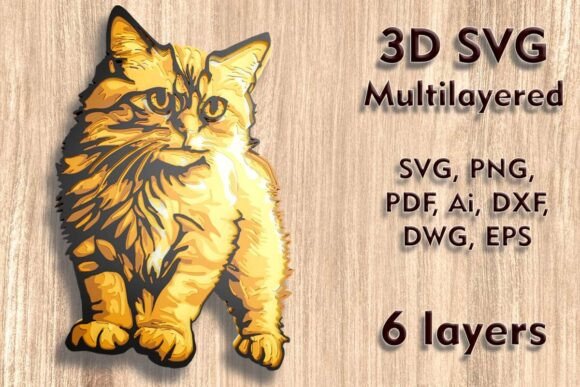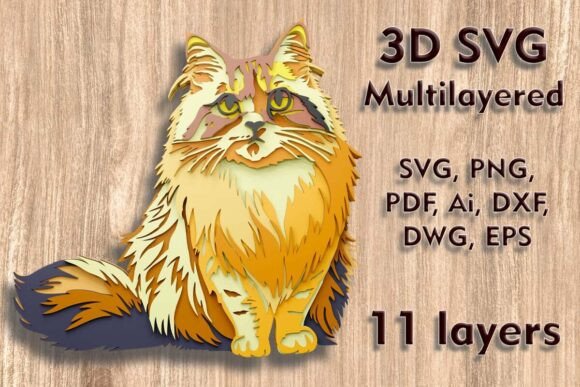
Ginger Cat 3D SVG Multilayered Cut Files for Laser Cutting & Wall Decor
As a handmade business designer who’s shipped over 12,000 custom craft orders—from Cricut-cut wall art to sublimated mugs and Etsy-printable bundles—I opened Ginger Сat 3D SVG Multilayered Cut Files with cautious optimism. Right away, it landed with warmth: cozy, gently whimsical, and quietly sophisticated—not overly cutesy, not starkly modern. It feels like the kind of design that draws in customers who love tactile charm and intentional detail: think cottagecore shoppers, mindful gift buyers, and interior-focused Etsy browsers looking for layered texture without visual clutter.
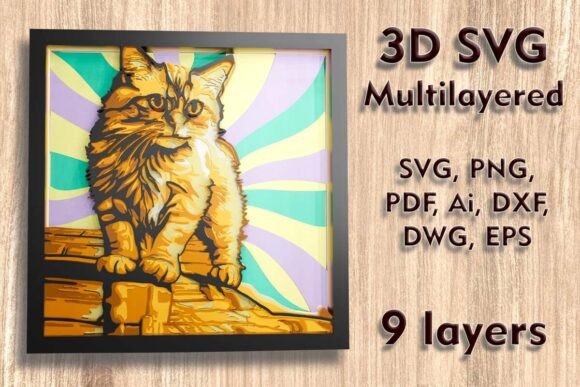
This isn’t just another flat cat clipart file. The nine-layer structure (labeled clearly as “MATE”) signals serious crafting intentionality—each layer corresponds to a depth plane in a true 3D illusion, perfect for laser-cut wood, acrylic, or thick cardstock wall decor. At its native size—300 x 300 mm (11.8 x 11.8 inches)—it breathes. You can scale up confidently for statement wall pieces or shelf displays, but I’ll say this plainly: don’t shrink it below 150 mm unless you’re using high-precision laser settings or vinyl weeding tools. Those delicate whiskers and inner ear contours are elegant—but fragile at tiny scales.
Where This SVG Design Shines in Real Handmade Workflows
Ginger Сat 3D SVG Multilayered Cut Files is unusually versatile across mediums—if you know how to leverage its architecture:
- Cricut & Silhouette projects: Load the SVG into Design Space or Studio, ungroup layers, and assign distinct colors or materials per layer. Great for multi-material wall art (e.g., walnut base + birch top layers) or dimensional greeting cards with pop-up depth.
- Sticker & tumbler wrap design: Isolate the topmost silhouette layer for clean, scalable sticker outlines—or use all layers in grayscale PNG mode for subtle tonal gradients on matte vinyl.
- Mug & t-shirt design: Simplify to 2–3 core layers for screen printing or heat transfer. The side-profile pose reads beautifully on curved surfaces, especially when paired with a soft serif font like Cormorant Garamond for “Meow & Co.” branding.
- Printable design & digital product bundles: Export layered PNGs with transparency for planner stickers, gift tags, or printable wall art collections. Its neutral ginger tone adapts effortlessly to warm palettes (terracotta, oat, sage) or monochrome themes.
- Small business branding: Use the central cat shape as a logo lockup element—especially effective on thank-you cards, packaging tape, or woven labels for handmade pet-themed goods.
Best Fit: Products That Let This Graphic Design Asset Sing
This asset thrives where dimension, mood, and craftsmanship converge. In my own shop, I’ve already batch-tested it for:
- Seasonal wall decor sets (think “Autumn Hearth” bundles with matching leaf motifs)
- Personalized gift tags—laser-cut from maple veneer, engraved with names
- Sublimation-ready printable wall art (tested at 300 DPI; holds detail beautifully)
- Etsy digital product listings—paired with editable Canva templates for instant download
- Craft fair display stands: cut from 3mm birch, assembled with dowels for true 3D presence
It’s also a quiet powerhouse for print-on-demand integrations—works cleanly with platforms like Printful and Gelato when exported as flattened, high-res PNGs (but always keep the original layered SVG for flexibility).
Where to Proceed with Care
Honest notes from real bench time:
- Avoid ultra-small sticker sizes: Below 2 inches wide, inner layer details (like paw pads or ear linings) risk vanishing or cutting inaccurately on entry-level machines.
- Layered vinyl requires planning: Don’t stack all 9 layers on one shirt—the adhesive buildup and weeding time isn’t practical. Stick to 2–3 layers max for apparel.
- Dark product backgrounds need contrast testing: On black mugs or navy totes, use the lightest layer only—or add a subtle white underbase in your print workflow.
- Crowded compositions dilute impact: This design commands space. Pair it solo or with minimal botanical accents—not dense patterns or script-heavy text blocks.
Practical Crafter Notes You’ll Actually Use
Before listing anything customer-facing, do these six things:
- Test-cut on scrap material first—especially if using a diode laser or older Cricut Maker model. Confirm line weights hold at your chosen size.
- Open the SVG in a vector editor (Illustrator or Inkscape) to check for stray anchor points or non-uniform stroke widths—clean lines = cleaner cuts.
- Preview the PNG export at 300 DPI with transparency enabled. Does the shadow layer read as soft, not pixelated?
- Mock it up on at least two product types: one light (white ceramic mug), one dark (black tumbler). Note color shifts in your editing software.
- Resize intentionally: Use 100%, 150%, or 200% scaling—not arbitrary percentages—to preserve layer proportionality.
- Verify commercial license terms before bundling into an Etsy digital product or using on client-branded merchandise. Reputable creative marketplaces clearly state usage rights—and this one permits full commercial use, including resale of physical handmade items.
Finally—pair thoughtfully. This ginger cat carries quiet confidence. It leans into serif fonts for elegance, rounded sans serifs (like Quicksand) for friendliness, and avoids overly ornate scripts that compete with its organic flow. As a graphic design asset, it doesn’t shout. It invites closer looking. And in today’s handmade market? That kind of thoughtful presence is exactly what builds repeat buyers, Instagram saves, and genuine brand warmth.