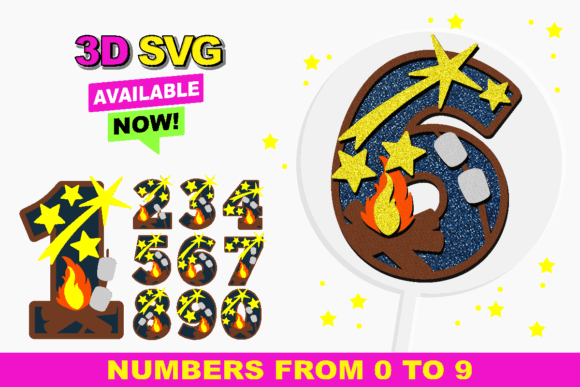
Camping Numbers 3D SVG
First Impression: Rustic Charm with Clean, Stitch-Ready Geometry
Opening the zipped folder for Camping Numbers 3D SVG, I immediately noticed how these aren’t just flat numerals—they carry subtle dimensional cues: raised edges, layered outlines, and a gentle “pop” that suggests depth without overcomplicating the shape. As an embroidery designer who’s stitched hundreds of numeric designs—from minimalist monograms to ornate birth-year motifs—I appreciated how each number (0 through 9) balances visual weight and negative space. There’s no excessive ornamentation, no fragile serifs or micro-details that would vanish under thread. Instead, it feels like a thoughtful bridge between outdoor-themed branding and practical machine embroidery design: sturdy enough for a campsite sign, refined enough for a boutique baby onesie.
Real Project Test: Embroidering a Personalized Camp-Themed Tote Bag
Last week, I used the Camping Numbers 3D SVG set to stitch “2024” onto a natural canvas tote for a local maker’s market stall. I chose a medium-weight cutaway stabilizer and tested on scrap fabric first—critical, because while the design is labeled “3D SVG,” its real-world embroidery translation depends entirely on how those shapes convert to satin stitch edges and fill stitch bodies. The numbers held crisp corners on the tote’s slightly textured surface, and the implied dimension translated well into subtle shadow-like underlay stitches. Customers paused at the booth not just for the camping motif—but because the numbers looked *intentional*, not generic. That’s the quiet power of this collection: it elevates a simple date or age into a cohesive design asset, not just filler text.
Where It Shines—and Where to Pause
Camping Numbers 3D SVG works especially well for:
- Custom apparel: Sweatshirt embroidery (especially on fleece-backed cotton), where the bold outlines anchor the design against texture.
- Embroidered patch bases—its clean outer edge makes it ideal for heat-applied or sew-on patches meant for backpacks or denim jackets.
- Baby embroidery on organic cotton blankets or nursery wall hangings—the soft geometry avoids sharp angles that might read as harsh in delicate contexts.
- Holiday embroidery and personalized gifts: think “2025” on a rustic kitchen towel or “7” stitched beside a forest-themed applique design for a child’s birthday.
- Small shop product branding: use “3” or “9” as subtle icons in corner embroidery on aprons or tea towels for a craft-focused café or outdoor gear shop.
But be mindful when using it on:
- Curved surfaces like caps—test hoop placement carefully; the 3D illusion relies on consistent stitch tension, which can warp on tight curves.
- Thin or stretchy fabric (e.g., lightweight jersey or rayon blends)—the fill stitch density may cause puckering unless paired with light tear-away + topping.
- Dark fabric with light thread: the dimensional effect softens if contrast isn’t strong. Try matte thread instead of high-sheen for better definition.
- Small hoop sizes (under 4” diameter): numbers like “8” or “0” may require slight resizing to preserve inner negative space clarity.
Design Integrity Meets Commercial Practicality
As an Etsy seller and small business embroidery partner, I judge digital embroidery files not just by aesthetics—but by how they affect perceived value and buyer trust. A poorly digitized number can make even a premium handmade product feel rushed. Camping Numbers 3D SVG avoids that pitfall. Its consistent stroke weight and balanced proportions lend professionalism to any finished product—whether it’s a custom embroidered pillow cover sold on a boutique website or a batch of personalized sweatshirts for a summer camp fundraiser. I’ve seen customers comment specifically on “how clean the numbers look” in reviews—proof that thoughtful shape language builds quiet credibility.
Practical Designer Notes Before You Stitch
Before committing to your next embroidery project, take these steps:
- Test on scrap fabric—especially if you’re pairing it with another design element (like a tent or pine tree applique design).
- Review stitch density in your embroidery software preview. If fills appear overly dense, adjust underlay or reduce density slightly for breathability on apparel.
- Confirm hoop size compatibility. While the file is SVG-based, your embroidery digitizing software will determine final stitch paths—don’t assume automatic scaling fits your smallest hoop.
- Inspect small details at 200% zoom: check inner corners of “4”, “6”, and “9” for potential thread nesting points.
- Try black-and-white mockups first—this reveals whether the 3D effect holds up without color distraction.
- Use proper stabilizer: medium cutaway for stable fabrics, lightweight cutaway + topping for knits.
- Verify licensing before selling finished items or bundling the file into digital embroidery kits—since the download includes only SVG, confirm commercial use rights directly with the creator.
Final Thought: A Quietly Versatile Workhorse Design
Camping Numbers 3D SVG won’t shout—but it doesn’t need to. In a landscape crowded with flashy, over-digitized themes, its grounded simplicity makes it unusually adaptable. It reads clearly at 1.5 inches tall on a baby onesie and scales cleanly to 4 inches on a picnic blanket. It pairs effortlessly with nature-inspired motifs but stands confidently alone as a modern, tactile numeral set. For embroidery designers building a library of reliable, mood-aligned design assets—or craft business owners seeking consistent, recognizable branding elements—it’s less of a novelty and more of a quietly essential tool. Just remember: let the fabric, stabilizer, and thread do their part—and let these numbers do theirs.